Choosing the right system
Choosing the right access cover for the given application is essential to prevent problems and product failures in the future. The key factors to consider are listed below and covered in more detail through each of the links.
ACO’s Technical Services can also offer additional advice and assistance in choosing the right access cover.
 Loadings
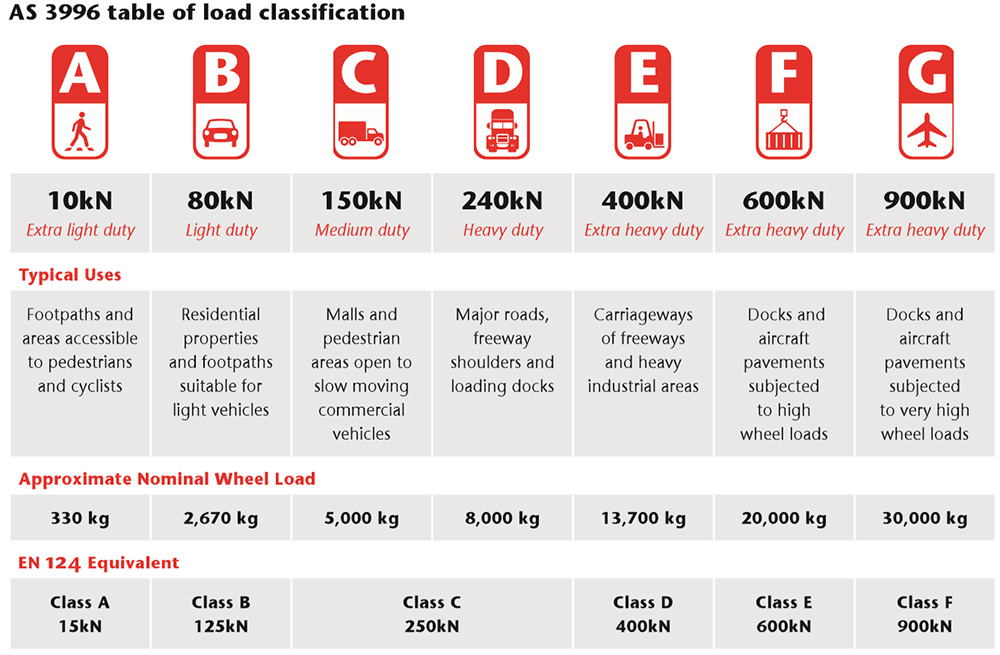
Choose the right cover and frame to withstand the anticipated type and frequency of traffic. ACO’s covers are certified to AS 3996 loadings.
AS 3996 – Clause 1.1 Scope*
“This Standard specifies requirements for access covers and grates for use in vehicular and pedestrian areas. It applies to single or multi-part access covers & grates, where any single cover does not exceed 1300mm clear opening. This Standard covers products manufactured from grey and ductile iron, cast and manufactured steel, aluminium, concrete and polymeric materials.”

NATA Certification
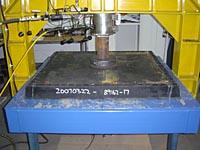
As part of ACO’s continuous product development and commitment to quality, ACO has NATA certified testing equipment (Licence no. 15193), operated by fully trained and certified technicians.
In practice, there are a number of key factors affecting a cover’s resistance to load:
- Type of traffic - pedestrians, cars, trucks, forklifts etc. crossing the cover. For trolleys and forklifts particularly, consider the weight of loads being carried.
- Frequency of traffic - more frequent traffic may require a heavier load class.
- Speed of traffic - fast moving traffic can intensify the load effect on the cover.
- Position of cover - if the cover is positioned where traffic will be turning, braking or if the cover is installed at the bottom of a ramp, it will be subjected to extreme forces. Selecting the right cover and frame is essential.
- Wheel type - solid tyres exert loads through smaller contact areas than pneumatic tyres. A heavier duty cover may be required.
 Size
Size
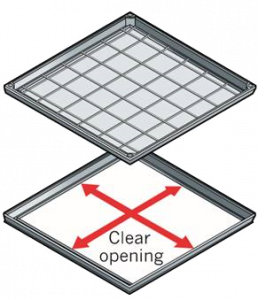
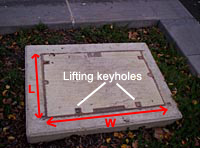
Clear Opening – The unobstructed opening inside the frame. Dimensions are given as width (W) by length (L).
Rhinocast covers are specified with the width parallel to the lifting ends. Length is parallel to the direction of cover removal.
 Single cover
An access cover system where a single cover is used.
Two-part
An access cover system where two covers are seated lengthways on a single frame.
Three-part
An access cover system where three covers are seated lengthways an a single frame.
Trench Run
An access cover system where multiple covers are seated lengthways on a single frame.
Multi-part
An access cover system where multiple covers are seated both lengthways and widthways on a single frame. Beams are required to support the covers but are removable to provide full access.
 Aesthetics
Infill Materials
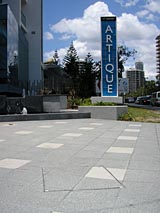
Recessed covers offer the ability to fill the cover with material to match or complement the surrounding pavement.
A maximum tile depth of 25mm and maximum paver depth of 40mm is recommended.
Tiles or pavers must be fully restrained and bonded to the concrete bed to prevent damage to the cover. An epoxy mortar is recommended.
Decorative edging
A strip of stainless steel or brass can be fixed to the edge of the cover and frame for an attractive finish
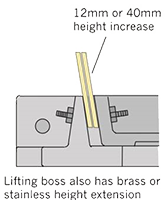
Ductile iron covers
Height increase : 12mm or 40mm
Width/Length increase : 12mm
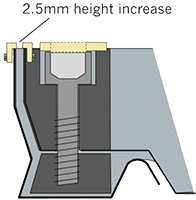
Galvanised steel covers
Height increase : 2.5mm
Width/Length increase : 2.5mm
ACO also offers iron covers with reduced ribs and therefore do not require edging if pavers/tiles up to 40mm thickness are used.
To view the range, click here
 Security
Locking
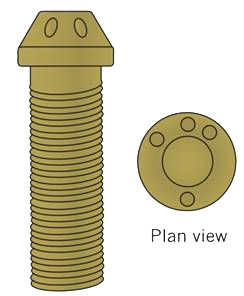
For additional security or back pressure applications, locking bolts can be added to the cover. Locking bosses are fitted to the cover. The cover and frame is drilled and tapped to accept the locking bolt.
Note: the following covers are locked as standard;
- All Rhinocast® solid top & infill circular, square, rectangular covers are standard with holding down bolts
- All Urbanfil® galvanised steel covers
- Servokat covers
Barri Bolt
A tamper resistant locking bolt for security applications. Special tools are required to remove the bolt.
Gas & Water Tightness
All standard covers are gas and water sealed as standard, to normal atmospheric pressure (up to 1kPa). This type of seal also offers a seal against odours.
Pressure tight
For applications where back pressure is over 1kPa the addition of locking bolts prevents the ingress of gas or water.
Single Seal
There is one point of contact between the frame and cover where the seal is achieved. The seal can be achieved with grease (Rhinocast) or a ‘rubber’ gasket (Urbanfil & Servokat).

Cover Orientation
Traffic Flow
For Rhinocast® covers, the drawcut edge should face the orientation traffic flow to prevent cover lifting. Note: the lifting holes are positioned above the drawcut cover / frame.

Cover Removal
For Rhinocast® cover, covers should be positioned to avoid obstacles (such as walls, barriers, kerbs, etc.) that may prevent easy cover removal.
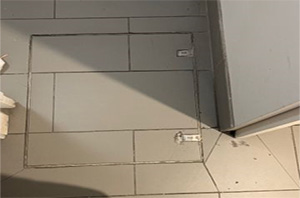
This is an example of an incorrectly positioned single part tile filled cover. Note the position of the lifting holes adjacent to the wall

This is an example of an incorrectly positioned multipart. Note the position of the lifting holes adjacent to the wall.
Handling
Work Cover Guidelines
Work Cover National Code of Practice for Manual Handling recommends a maximum unassisted lifting weight of 55kg. Weights above this require the use of mechanical lifters. All Hermelock® composite covers comply with this code.
Note: Certain states/companies may have different maximum lifting requirements.
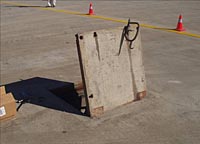
Servokat – assisted lift cover systems
Assisted lift
A gas strut is fitted to the frame and cover to enable the cover to be easily lifted.
Refer to Servokat covers
Lifting Keys
Ductile iron and galvanised steel covers can be lifted using standard Australian lifting keys. A selection of short handle, long handle and mechanical lifters are available.
For more information:
CPD training
In today’s ever-changing construction industry, it has never been more important to ensure you are up to date with current industry regulations, practices, trends and innovations.
With a series of free Continuing Professional Development (CPD) and industry specific courses, we provide essential learning and knowledge to construction professionals, ensuring you can undertake professional development when and where you need it.
Continuous professional development is a commitment required by chartered bodies to develop your career and encourage lifelong learning. Some courses have been accredited by professional associations such as Engineers Australia (EA), Australian Institute of Landscape Architects (AILA) and Architectural Information Services (AIS).

Click here to view all courses.